SSO Agency · November 22, 2026
AI Agents Versus Chatbots: What to Build
A support team that answers the same 20 questions every day has a very different problem from an operations team that must reconcile orders, update systems, flag exceptions, and request approvals. That distinction is where the AI agents versus chatbots decision becomes practical. One may need a focused conversational interface. The other may benefit from an AI system that can reason through a defined workflow and take controlled action.
The labels are often used interchangeably, which creates expensive confusion. A chatbot can be useful without being an agent. An agent can deliver meaningful operational leverage, but it also introduces more integration, governance, and maintenance responsibility. The right choice depends on the business process, the quality of available data, the cost of errors, and the level of control your team needs.
AI agents versus chatbots: the core difference
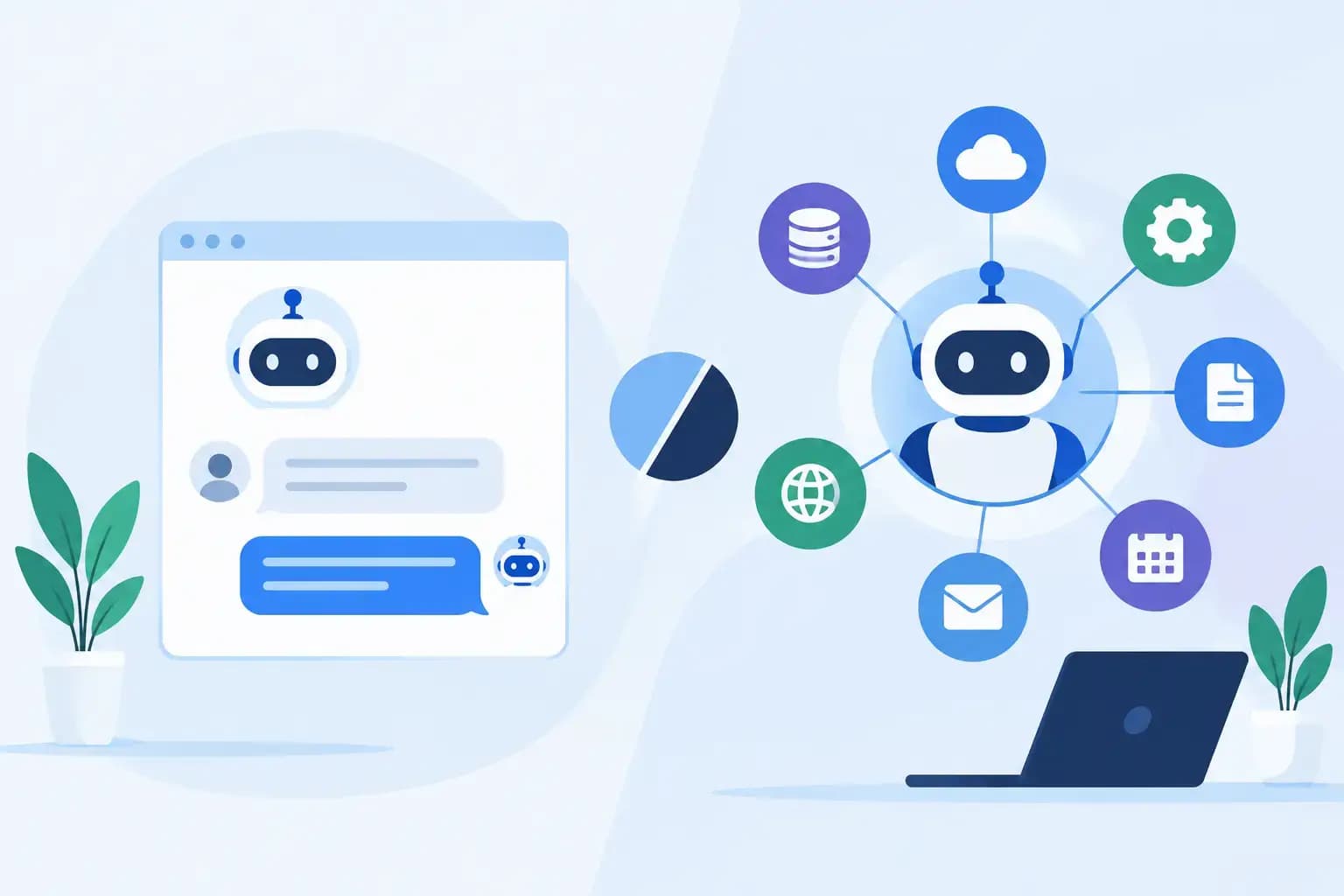
A chatbot is primarily designed to hold a conversation. It receives a user message, interprets it, and produces a response. The most capable chatbots can search approved knowledge, summarize records, guide users through a process, and hand a request to a human. Their main job is to make information and assistance easier to access through natural language.
An AI agent has a broader job. It can use a set of tools to pursue a defined objective across multiple steps. For example, an agent may read an inbound request, look up account details in a CRM, validate information against internal policy, prepare a response, create a task in a project system, and route an exception for approval. It is not merely answering a question. It is participating in a workflow.
Autonomy is the practical dividing line. A chatbot may suggest the next step to a person. An agent may execute that step, within clearly defined permissions and rules. That added capability is valuable when it removes recurring manual work, but it also means the organization must be more deliberate about access, logging, testing, and escalation paths.
This is not a hierarchy where agents are automatically better. A well-built chatbot can solve a narrow, high-volume problem with less cost and lower risk. An agent is justified when the work requires coordinated actions across systems and the process is stable enough to automate.
When a chatbot is the better business decision
Chatbots work best when the primary need is retrieval, guidance, or structured intake. Internal IT and HR knowledge assistants are common examples. So are customer-facing support assistants that answer product questions, collect troubleshooting details, or direct customers to the correct team.
The value comes from shortening the path between a question and a trustworthy answer. A chatbot can reduce repetitive requests without changing the underlying business process. That makes it a sensible first implementation for teams with scattered documentation, slow response times, or a growing volume of routine inquiries.
A chatbot is also easier to constrain. It can be limited to approved knowledge sources, prevented from accessing sensitive systems, and configured to say when it does not know an answer. For customer interactions, that restraint is often a feature rather than a limitation. An incorrect answer is inconvenient. An unauthorized account change or inaccurate refund is a larger operational and reputational problem.
That said, a chatbot connected to unreliable documentation will reproduce that unreliability at speed. Before deploying one, identify the source of truth, establish content ownership, and decide how outdated answers will be corrected. The conversational layer is only as useful as the information and process behind it.
When an AI agent earns the added complexity
An agent becomes compelling when people spend substantial time moving information between systems, checking predictable conditions, and coordinating routine next steps. Revenue operations, client onboarding, fulfillment, finance operations, and agency delivery are frequent candidates.
Consider a new-client onboarding workflow. A chatbot could answer questions about required documents. An agent could monitor submitted information, check whether required fields are complete, create implementation tasks, update the CRM, prepare a project brief from discovery notes, and notify the appropriate owner when an approval is needed. The result is not just faster answers. It is less coordination work across the team.
The strongest agent opportunities share a few characteristics. The process has a clear trigger, the systems involved have usable integrations, the desired outcome is measurable, and exceptions can be identified. If the workflow changes every week, relies on unwritten judgment, or lacks reliable data, building an agent too early can create a fragile layer on top of an already unclear process.
In those cases, first simplify the workflow. Standardize intake fields, clarify handoffs, document approval rules, and resolve duplicate or missing data. Automation should reduce a proven bottleneck, not hide a process that still needs management attention.
The risk is in the actions, not the conversation
The most consequential design question is not whether a system uses an advanced model. It is what the system is allowed to do after it reaches a conclusion.
An agent that drafts a customer email presents one level of risk. An agent that changes contract terms, issues refunds, modifies user permissions, or deletes records presents another. The solution is not to avoid agents altogether. It is to match permissions to the consequences of an error.
For many business workflows, a human-in-the-loop design is the right starting point. The agent gathers context, performs checks, prepares the recommended action, and sends it to a qualified employee for approval. As the workflow proves reliable, certain low-risk actions can become automatic. This approach builds operational confidence without handing over critical decisions before the controls are ready.
A production-ready implementation should define who can invoke the system, what data it can access, which tools it can use, what it may change, and when it must stop and escalate. It also needs audit logs that let your team reconstruct what happened. This is especially important when systems contain customer, financial, employee, or proprietary data.
Build workflows, not open-ended autonomy
The phrase “autonomous agent” can encourage the wrong implementation approach. Most companies do not need software that improvises freely across their systems. They need a reliable workflow that can use AI where interpretation is useful and conventional software where deterministic logic is better.
For example, AI may classify an inbound request, extract details from a document, summarize a call transcript, or recommend how to route an exception. Standard rules should handle permission checks, required fields, system updates, and approval thresholds. This separation makes the solution easier to test, explain, and maintain.
A useful pattern is to give the agent a narrow operational role with a defined set of tools. An accounts-receivable agent might review a queue, identify missing information, draft follow-ups, and create tasks for disputed invoices. It should not have unrestricted access to every customer record or the authority to alter payment terms without review.
This design also makes scaling more manageable. Rather than building one broad assistant that claims to handle every business question, build targeted capabilities around high-value workflows. Each can be measured, improved, and governed independently.
How to choose what to build first
Start with the workflow, not the technology. Talk to the people doing the work and map the actual path from trigger to completed outcome. The official process and the real process are often different. Those differences reveal the exceptions, data gaps, and approval dependencies that determine whether a chatbot, agent, conventional automation, or process redesign is the right investment.
Evaluate candidate use cases against four practical questions:
- Is the work frequent enough that reducing manual effort matters?
- Is the input data accessible, reasonably accurate, and permitted for this use?
- Can the desired action be clearly defined and checked?
- What is the business and operational cost if the system is wrong?
A high-volume, low-risk knowledge request is usually a chatbot opportunity. A repeatable, multi-step workflow with stable rules may be an agent opportunity. A process with inconsistent data and costly mistakes may need better systems and operating discipline before either approach.
It is also worth assessing the integration layer early. Many promising ideas fail not because the model is incapable, but because key records are trapped in disconnected tools, APIs are limited, or access controls were never designed for automation. These are architecture and operating-model decisions, not details to postpone until after a prototype receives positive feedback.
From prototype to dependable operation
A prototype can establish whether users find an AI interface helpful. It does not establish that the system is ready to run an important business process. Production work requires evaluation criteria, failure handling, observability, security review, and ownership after launch.
Test the system with realistic edge cases, not only clean examples. Include incomplete requests, conflicting records, ambiguous language, unauthorized users, unavailable integrations, and policy exceptions. Decide in advance what the system should do in each case. Often the correct behavior is to pause, explain the missing information, and route the case to a person.
Measure outcomes that connect to the original business objective. For a chatbot, that may include resolution quality, appropriate escalation, and reduced time to answer. For an agent, it may include completed workflow steps, exception rates, review time, rework, and the amount of manual coordination removed. These measures help teams improve the system based on evidence rather than enthusiasm.
SSO Agency approaches these decisions as an assessment and delivery problem: identify the bottleneck, validate feasibility and risk, then build the smallest system that can produce measurable operational value. The goal is not to add AI to every interaction. It is to strengthen the technology foundation while removing the manual work that holds growth back.
The most useful question is not whether your company needs an agent or a chatbot. Ask which recurring decision or handoff is slowing the business down, what degree of automation it can safely support, and what controls will let your team trust the result. Start there, and the right architecture becomes much clearer.